The aim of this project is to redesign an existing blood pump for more pressure rise for acute decompensated heart failure (ADHF) treatment application. The working fluid is blood and the pump’s configuration is axial. The main geometrical constraint for the redesign is the maximum OD of the impeller casing which cannot exceed 4.0 mm.
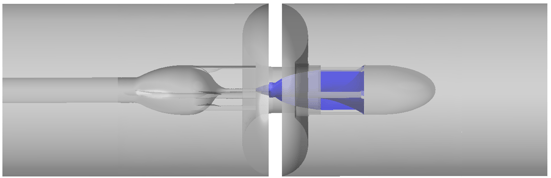
Fig 1. Computational domain and CFD model for the final impeller design
Deliverables
1. CFD simulation results of the existing pump design including pressure rise, power and efficiency
2. CFD simulation results of the new pump design including pressure rise, power and efficiency
3. 3D CAD geometries of the new pump design.
Impacts
The new design shows 20% improvement of pressure rise and 4 percentage point improvement of efficiency compared to the existing design with the same rotating speed and flow rate.
Products Used: TURBOdesign Pre, TURBOdesign1
BASELINE DESIGN CAD AND CFD ANALYSIS
The baseline 3D CAD geometries are simplified and prepared for the meshing. ANSYS Meshing is used to create the computational domain with unstructured mesh.
Prism layers are added near the wall and the mesh size near in the small gaps is refined further to resolve the local flow properly.
ANSYS CFX is then used to run steady-state RANS simulations with laminar assumptions and different turbulence models (SST k-omega and k-epsilon).
The blood is modelled as a Newtonian fluid with constant density and viscosity.
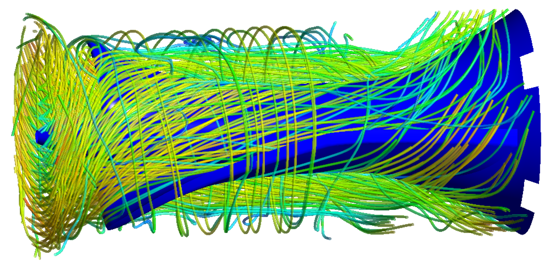
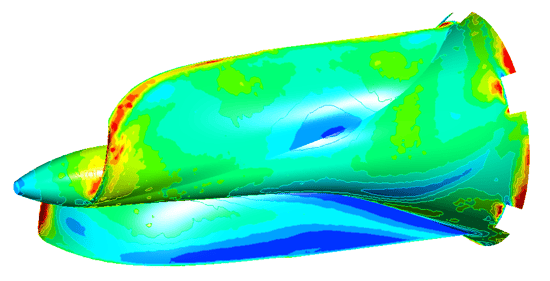
The CFD results including pressure rise, power and efficiency can be obtained and compared with the CFD results (using a different CFD solver) and test data of the existing design provided by the customer. 3D streamlines, wall shear stress and flow shear stress contours can be plotted and used to detect the regions with high losses.
NEW IMPELLER DESIGN USING INVERSE DESIGN METHOD
TURBOdesign Pre is used to carry out a meanline analysis with the given geometrical constraint. The resulting meridional geometry is passed on to TURBOdesign1 and 3D blade shape can be generated using the 3D inverse design code iteratively.
The blade thickness is kept the same as the baseline. The same CFD model is used to allow for a back-to-back comparison of the performance. A number of design iterations have been performed to vary the meridional geometry parameters, blade loading parameters and the blade number to achieve higher pressure rise, same or lower wall shear stress and flow shear stress compared to the baseline.
Shear stress is used as a measure for hemolysis. ADT has used experimentally verified methods of quantifying hemolysis in other projects.
CFD ANALYSIS FOR THE FINAL IMPELLER DESIGN
Steady-state CFD results confirm that the new design has 20% higher pressure rise and 4 percentage points higher efficiency compared to the baseline design. 3D unsteady URANS simulations show that the new design has 30% less pressure rise fluctuation (more stable head output) compared to the baseline.