


HACKER is a family-operated Brazilian company, specializing in the design and manufacturing of high-performance hydraulic turbines and equipment for the power generation market. With more than 70 years of experience, the company offers a complete portfolio that includes Kaplan, Francis, Pelton and Bulb turbines, as well as generators, bearings and a full range of hydropower components.
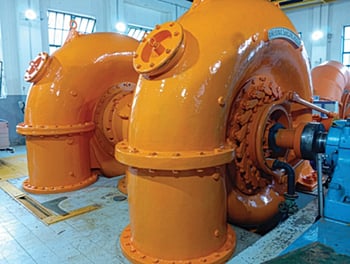 Fig 1: HACKER Refurbished Turbine
Known for its precision engineering and robust quality standards, HACKER serves both new hydropower developments and the refurbishment or modernization of existing plants. With an advanced engineering team, a solid manufacturing base in southern Brazil and partnerships in Europe and North America, the company continues to expand internationally.
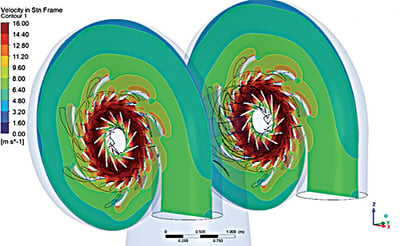
Fig 2: CFD Pressure Velocity Fields
HACKER are now using TURBOdesign Suite to break away from a design-from-legacy approach and embrace the power of inverse design. Resulting in faster development times and a radical leap in component performance.
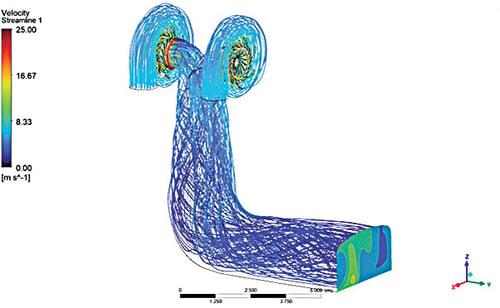
Fig 3: CFD Pressure Velocity Fields
At time of writing, HACKER have carried out four refurbishment projects using TURBOdesign Suite. Before adopting the software, their ability to optimize upgrade projects was limited by the requirement that the refurbishment had to be based on existing hydraulic designs and model test data. This approach only worked when there was a significant level of similarity between the meridional geometry of the legacy turbine and the turbine to be refurbished, often resulting in long engineering cycles spent comparing and testing multiple legacy designs with similar operating data and geometry. In some cases, it was not even possible to achieve satisfactory efficiency or cavitation performance using the internal design database, so overall results were very limited.
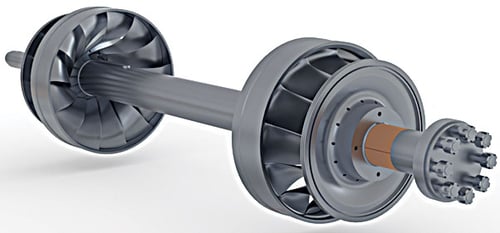
Fig 4: CAD Rendering
With TURBOdesign Suite, HACKER are now able to develop solutions specifically tailored to the project conditions and to the geometric constraints of each unit.
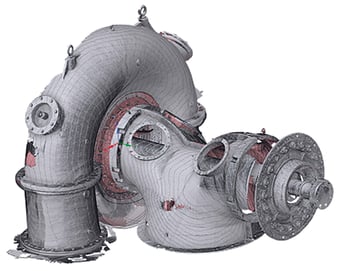
Fig 5: Extraction of the Geometry
The project in this case study involved the upgrade of a double-Francis turbine with two spiral casings and a shared draft tube. The elements that could be modified were limited to the shape of the guide vanes (but not their quantity), the meridional profile (while preserving the guide vane height and the draft-tube inlet diameter), and the rotor blade shape and blade count. The main challenge was the high turbine setting (6 m), and the goal was to achieve 2,878 kW of mechanical power at 32m of net head with improved efficiency. Given the complexity and geometric constraints involved, it was clear that relying on legacy profiles would have required a much more difficult and time-consuming engineering effort than attempting a new design. So the ability of TURBOdesign Suite to deliver a compelling solution was the key to the success of this project.
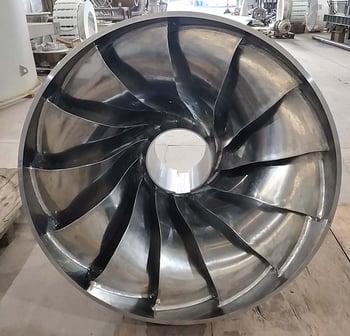
Fig 6: Runner
After a short training and trial period, fully supported by ADT, HACKER engineers were able to jump straight into this upgrade project using their existing computational hardware and systems. In particular they were impressed by:
The ability to base the design, from the very start, within a defined meridional envelope which allows the solution to fit precisely within the geometric constraints.
Reverse-engineering tools and User Defined Functions that enabled detailed comparison of new geometries with the legacy turbine.
The ability to predict blade loading within seconds, which became one of the standard checks for any generated candidate geometry.
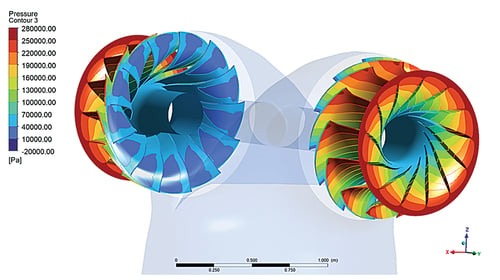
Fig 7: CFD Pressure Velocity Fields