Book a LIVE demo on the design of a turbomachinery application of your choice.
Our demo is tailored to your specific application and design challenges



Ebara Shinwa, founded in 1952 and one of the Ebara Group Companies, is a top manufacturer of cooling towers for air conditioning systems in Japan. The recent strong demand for energy-saving and environmentally friendly products, particularly in reference to improvements in efficiency and noise reduction of axial flow fans used in the cooling tower, have become crucial. Ebara Shinwa therefore decided to carry out a project for redesigning the current fan model using TURBOdesign1 as well as to clarify the impact of this new technology on their products line.
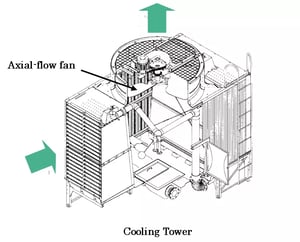
What are cooling tower fans?
A cooling tower is the component of air conditioning systems used to cool the circulating water. In this system, water droplets come in contact with fresh air, which in turn produces cool air, and an axial-flow fan is then used to create airflow in the cooling tower. Improvements to fan performance is very important, not only in terms of reducing energy waste but also in terms of noise reduction, as cooling towers are situated on a building’s exterior, often close to office and residence areas.
CFD analysis of the existing fan design, under ducted fan configuration, showed flow separations both at the hub and at the tip regions of the fan blade (see Fig. 2a). Additionally, the CFD analysis of the cooling tower and the evaluation of the inflow to the fan showed flow distortion at the fan inlet. Considering these factors, the design strategy was set as follows:
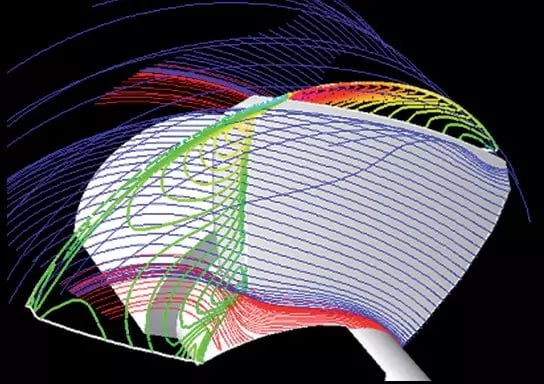
Design comparison
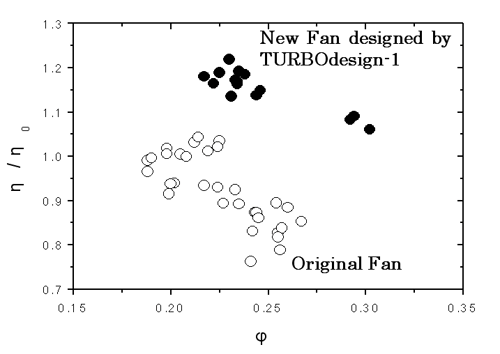
Following this design strategy, several different axial-flow fan blades were designed and evaluated by CFD. The final design exhibits well-suppressed flow separation at the tip as well as the improved flow pattern at the hub (see Figure 2b). The new axial-flow fan designed by TURBOdesign1 was installed into the cooling tower and tested under actual operating conditions. A significant improvement was gained across the whole flow range in the fan efficiency, with the efficiency increase more than 20% (see Fig. 3). Additionally, the noise level was also improved, particularly at higher frequency range.
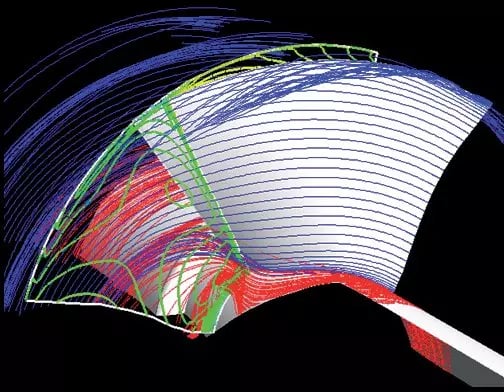
Blade design using TURBOdesign1 enabled the inclusion of the effects of inflow non-uniformity and the control of the overall blade loading, which minimized the flow losses caused by the interaction between the fan rotor and the surrounding components. Ebara Shinwa confirmed the benefit and potential of incorporating TURBOdesign1 to renovate their product line and thus, further enhance the competitiveness.
Our demo is tailored to your specific application and design challenges