
The client is a major manufacturer of large industrial pumps. They needed an accurate performance prediction of a double-suction volute pump with an estimated design flow rate of 6.00 cubic meters per second. The impeller had to be redesigned in case the existing design did not meet the target performance in terms of head, efficiency and off-design requirements. The client provided ADT with the inlet duct and volute geometry and an initial design of the impeller.
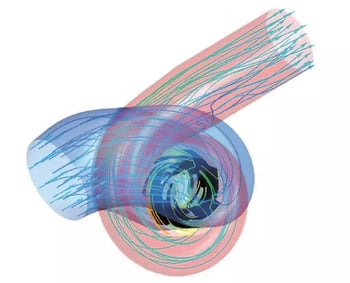
ADT performed a detailed CFD analysis of the pump stage. Due to strong interaction between components, full stage analysis was required to predict the performance characteristics. Figure 1 shows the pump stage CFD model. The analysis results showed that the best efficiency point of the impeller was much higher than the pump nominal operating condition. Hence a redesign of the impeller was found to be necessary.
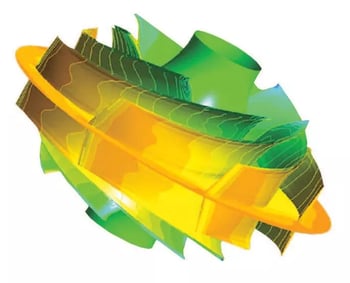
The impeller redesign was performed by TURBOdesign1 maintaining the same meridional shape as that of the original design, to ensure that a redesign of the casing and volute was not required. TURBOdesign1 allows the operating point of the impeller ( in terms of mass flow rate and required head ) to be explicitly specified, hence the designer can focus on optimising the hydraulic performance without the need to perform time consuming iterations to achieve the operating condition requirements.
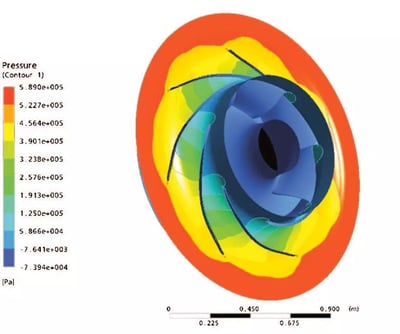
Stage analysis results of the redesigned impeller showed that required head and efficiency at the target operating point was obtained.