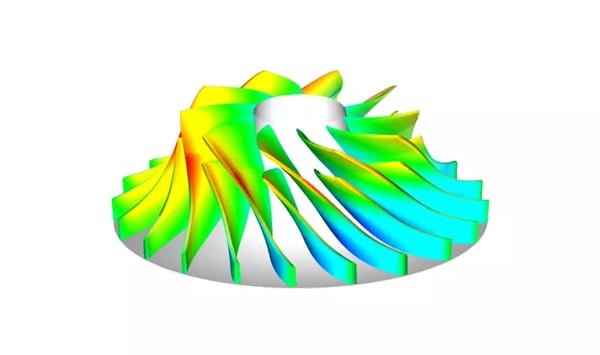

The China North Engine Research Institute (CNERI), founded in 1958, is a professional vehicle engines development laboratory located in Datong, China. CNERI belongs to China North Industries Group Corporation and is tasked with developing high speed, powerful internal combustion engines for motor vehicles, ships, engineering machinery and power generation.
Recently, CNERI engineers used a commercially available 3D Inverse Design software system, TURBOdesign Suite by Advanced Design Technology, to rapidly develop a new centrifugal compressor for an heavy truck turbocharger that provides superior, performance. They found that 3D inverse design methodology was the best way to achieve their goals.
Conventional design starts from an assumed blade shape whose performance is evaluated by computational fluid dynamics (CFD) codes. However, since the flow field is highly complex and three dimensional, and there is no direct relationship between the blade geometry and flow field, the design process has to rely on designer experience gained through many years of trial and error.
Generally speaking, experienced designers can achieve good designs by following closely what has worked in the past. However, such an approach can, inadvertently, result in a reduction of the explored design space as the designer tends to operate within his comfort zone. Hence, this approach makes it more difficult to achieve designs beyond previous experience, and this is one of the main causes of increasing difficulty in achieving further performance improvements.
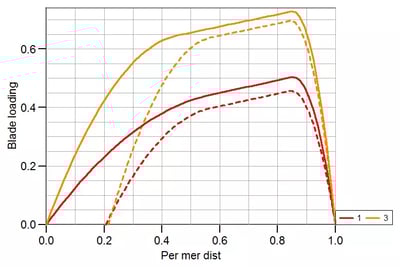
In the 3D Inverse Design approach, the blade geometry is computed for a given pressure or loading distribution. It’s a well known fact that the 3D pressure distribution controls the viscous behavior of the flow, and hence, by controlling the 3D pressure field, it is possible to directly use the detailed information provided by CFD solutions to arrive at a choice of optimum loading to control particular sources of performance loss in turbomachines.
The 3D inverse design approach therefore allows designers to directly use knowledge of fluid dynamics, as provided by CFD and detailed measurements, to arrive at breakthrough solutions that solve particular adverse flow phenomena.
CNERI engineers needed to design a new centrifugal compressor with splitter blades in order to achieve a unique product combining high performance and low development costs.

Solution
Because 3D inverse design provides the best means of rapidly designing 3D centrifugal compressor blades with superior performance, CNERI engineers used TURBOdesign Suite for their new centrifugal compressor.
Prior to using TURBOdesign Suite, CNERI engineers used another commercially available turbomachinery blade design software system based on 1D sizing, blade angles definition and historical design databases to attempt the new design work. It resulted in designs that were too similar to those developed before and therefore did not achieve their ambitious goals.
“The TURBOdesign software was more effective in developing an advanced solution and enabled us to shorten the design time,” says Zhang Jizhong, of CNERI. “Using it has given us some good ideas for new product designs.”
Implementing the new software system was straightforward. TURBOdesign Suite is available for download and runs on Windows systems. It operates on mid-range workstations with 2.4 Ghz or better processors, 2 GB RAM and 1Gb disk space. CNERI just purchased a dedicated workstation to support all their design activities.
CNERI engineers required some initial training which took about one week to complete. It took approximately six months to become completely versed in the software systems’ many features. Software support is included in the purchase, so ADT engineers were available throughout the process.
TURBOdesign1 was essential to help CNERI achieve high compressor performances, the advanced features providing detailed control of the blade loading and blade thickness allowed CNERI engineers to achieve a unique product combining superior aerodynamic performance and sound structural integrity.
“By using TURBOdesign Suite we were able to complete the development of a new, unique centrifugal compressor in half the time and costs it would have otherwise taken us” said Jizhong Zhang, “without the 3D inverse design method, it would have been very difficult to solve the new compressor design challenges”.